 Taxpayer Bill of Rights
The Taxpayer Bill of Rights (TBR) describes and defines 16 rights and builds upon the CRA's corporate values of professionalism, respect, integrity, and cooperation. It describes the treatment you are entitled to when you deal with the CRA. The TBR also sets out the CRA Commitment to Small Business to ensure their interactions with the CRA are conducted as efficiently and effectively as possible.
For more information about your rights and what you can expect when you deal with the CRA, go to canada.ca/taxpayer-rights.
Forms and publications
To get our forms and publications, go to canada.ca/get-cra-forms or call 1-800-959-8281.
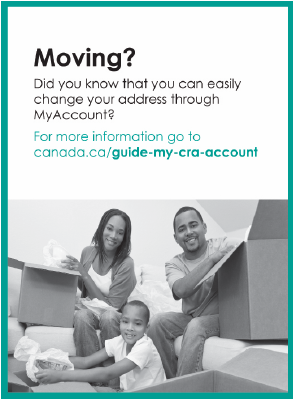
What should you do if you move?
If you move, let us know your new address as soon as possible. If you use direct deposit (see page 67), you also have to tell us if you change your account at a financial institution.
Keeping your information up to date will ensure that you keep receiving benefit payments to which you may be entitled and important correspondence from the CRA. Otherwise, your payments may stop or you may not receive important correspondence, such as your notice of assessment.
If you have registered with our My Account service or our mobile apps, you can change your address by going to canada.ca/my-cra-account or canada.ca/cra-mobile-apps and selecting MyCRA or MyBenefits CRA. If not, you must tell us your new address by phone or in writing, or by completing and sending Form RC325, Address change request.
If you are writing, send your letter to your tax centre. Include your social insurance number, your new address, the date of your move, and your signature. If you are writing for other people, including your spouse or common-law partner, include their social insurance numbers and have each of them sign the letter authorizing the change to their records.
Note
Because your personal information is confidential, we will not
usually give your new address to other government departments or
Crown corporations such as Canada Post.
Representatives
You can authorize a representative (such as your spouse or common-law partner, tax preparer, or accountant) to get information about your tax matters and give us information for you. We will accept information from or provide information to your representative only after we have received your authorization at canada.ca/my-cra-account, in writing, or by sending a completed Form T1013, Authorizing or Cancelling a Representative.
You can cancel the authorization online by using My Account, by telephone, in writing, or by sending Form T1013.
Your representative can cancel their authorization by using Represent a Client at canada.ca/taxes-representatives, by telephone, or in writing.
You do not have to complete a new form every year if there are no changes. Your authorization will stay in effect until it is cancelled by you or your representative, it reaches the expiry date you choose, or we receive notification of your death.
Legal representatives
A legal representative is an executor or administrator of the taxpayer's estate, someone with a power of attorney or guardian.
If you are a legal representative you must send a complete copy of the legal document giving you the authority to act in that capacity to the appropriate tax centre.
If you would like to have online access to the taxpayer's account, you need to register for Represent a Client at canada.ca/taxes-representatives to get your RepID. Once registered with the Represent a Client service, make sure you provide your RepID when you are submitting all the required documents naming you as the legal representative.
If you are the legal representative of a deceased person, see Guide T4011, Preparing Returns for Deceased Persons, to find out what documents are required.
For more information, go to canada.ca/my-cra-account or see Form T1013.
Service complaints
You can expect to be treated fairly under clear and established rules, and get a high level of service each time you deal with the CRA. See the Taxpayer Bill of Rights.
If you are not satisfied with the service you received, try to resolve the matter with the CRA employee you have been dealing with or call the telephone number provided in the CRA's correspondence. If you do not have contact information, go to canada.ca/cra-contact.
If you still disagree with the way your concerns were addressed, you can ask to discuss the matter with the employee's supervisor.
If you are still not satisfied, you can file a service complaint by filling out Form RC193, Service-Related Complaint. For more information and how to file a complaint, go to canada.ca/cra-service-complaints.
If the CRA has not resolved your service-related complaint, you can submit a complaint with the Office of the Taxpayers' Ombudsman.
Reprisal complaint
If you believe that you have experienced reprisal, fill out Form RC459, Reprisal Complaint.
For more information about reprisal complaints, go to canada.ca/cra-reprisal-complaints.

|

|