How to fill out the T3 slip
 How to fill out the T3 slip
Type or print the information on the slip. Report all amounts in Canadian dollars. If an amount was paid in foreign funds at various times throughout the year, to get the applicable rate, go to Exchange Rates.
If there is a preferred beneficiary election and other income is also allocated to the same beneficiary, fill out one T3 slip for the elected income and a separate slip for all other allocated income.
You can get the information needed to fill out boxes 21 to 57 from Schedule 9, Income Allocations and Designations to Beneficiaries.
Recipient's name and address - Enter the information in the white area provided. If the payment is to an individual, enter the beneficiary's name. If the payment is to a joint beneficiary, enter both names. If the payment is made to a trust, enter the name of the trust and not the names of the individual beneficiaries of that trust. If the payment is made to an association, organization, or institution, enter that name. Following the beneficiary's name, enter the beneficiary's full address including city and province or territory. Also include the postal code.
Year - Enter the applicable tax year at the top of the slip.
Trust year-end - Use a four-digit number to indicate the year, and a two-digit number to indicate the month of the trust's tax year-end.
Note |
|
For your convenience, the CRA has put the instructions for the following boxes in numeric order, even though the order on the slip may be different. The high-use boxes appear first, followed by the generic boxes. |
Box 12 - Recipient identification number
If the beneficiary is an individual (other than a trust), enter the individual's SIN.
If the beneficiary is a business (sole proprietor, corporation, or partnership), enter the 15 character program account number of the business.
If the beneficiary is a trust, enter the trust account number.
Note |
|
If you do not have the number, read the section titled Recipient identification number. Do not leave this box blank. |
Box 14 - Account number
You have to enter the trust's account number if the CRA has assigned one. Do not leave this box blank. For security purposes, do not include the trust account number on the copies you provide to the beneficiary.
1 alpha, 8 numeric:
-
T3 slip, box 14, example: T00000000
-
trust account number assigned by the CRA
-
must correspond to the "Trust account number" on the related T3 Summary record
-
if you have not been assigned such a number, enter T00000000 in the field.
Box 16 - Report code
Enter one of the following codes:
1 alpha

Note |
|
An amended return cannot contain an original T3 slip. |
If you use code A or C, read the section Amending, cancelling, adding, or replacing T3 slips for more information.
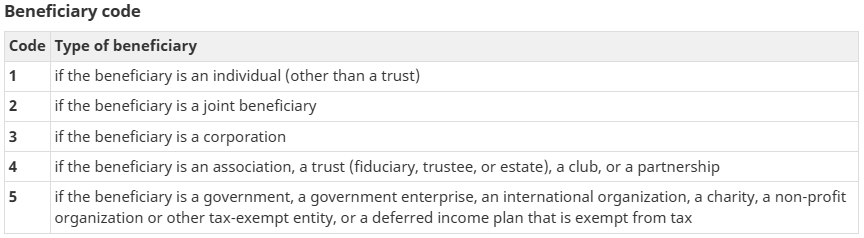
Box 18 - Beneficiary code
You have to enter one of the following codes to identify the type of beneficiary ( do not leave this box blank):
Note |
|
The instructions on the back of the T3 slip indicate that for amounts reported in certain boxes, footnote information must be entered in the footnote area below box 26. If you need more room to include an explanation in this area, prepare a separate statement and attach a copy to each copy of the slip. |
Box 21 - Capital gains
Enter the result of the beneficiary's share of the amount from line 921 of Schedule 9, multiplied by 2.
Note |
|
If box 21 includes capital gains from foreign property, enter an asterisk (*) beside the amount in box 21. In the footnote area, identify each country, enter "non-business income for foreign tax credit" and the taxable portion of the amount included in box 21 that relates to the disposition of foreign property. |
For more information, read Line 921 - Taxable capital gains.
Box 23 - Actual amount of dividends other than eligible dividends
Enter the beneficiary's share of the amount from line 923 of Schedule 9.
If the beneficiary is an individual or a trust (other than a registered charity), read box 32 and box 39 for more instructions.
Box 26 - Other income
Enter the beneficiary's share of the amount from line 926 of Schedule 9. Include amounts such as the following in this box:
-
death benefits
-
retiring allowances
-
pension income other than lump-sum pension benefits already included in box 22
-
net rental income
-
net business, farming, and fishing income
-
interest income
Notes |
|
Enter an asterisk (*) beside the amount in box 26 if it includes business, farming, or fishing income from a communal organization. In the footnote area, enter "self employment earnings for CPP purposes," and indicate the type of income-business, farming, or fishing-and the amount of the beneficiary's share. Enter an asterisk (*) beside the amount in box 26 if it includes any net rental income from real or immovable rental property transferred to the trust. In the footnote area, enter "Net rental income" included in "earned income," and indicate the amount of the beneficiary's share. No other footnotes are required for box 26. |
Box 30 - Capital gains eligible for deduction
Only personal trusts fill out box 30.
Enter the result of the beneficiary's share of the amount from line 930 of Schedule 9, multiplied by 2.
Where the trust has realized in its tax year both taxable capital gains which are eligible for a beneficiary's capital gains deduction, and taxable capital gains that are not eligible, very generally, the rules ensure that a proportionate share of each of the eligible taxable capital gain, and the non-eligible taxable capital gain is allocated and designated to each beneficiary. Subsection 104(21.2) provides the formulas to determine the amount of eligible taxable capital gains to designate in respect of QFFP and QSBCS. Very generally, the effect of each of these formulas is that the amount designated to a particular beneficiary is equal to the beneficiary's proportionate share of all the trust's subsection 104(21) designations for the year to its beneficiaries in respect of its net taxable capital gains for the year, to the extent that the amount so calculated represents eligible taxable capital gains of the trust for the year from the disposition of QFFP or QSBCS (depending on which formula is being applied).
The amount reported in Box 30 relates to the disposition of qualified small business corporation shares (QSBCS) and/or qualified farm or fishing property (QFFP) by the trust in the current year, or from a capital gains reserve claimed by the trust in a prior year.
Where the amount in box 30 includes an amount that relates to a disposition of QFFP or QSBCS by the trust in the current year, enter the amount of capital gains in box 55 or 57 respectively. Please see the instructions related to box 55 or 57.
Where the amount in box 30 includes an amount that relates to a capital gain reserve claimed in the trust's prior tax year and which is brought into the trust's income in the current year, enter an (*) beside the amount in box 30 and include the following in the footnote area:
-
the nature of the capital property disposed of (QSBCS and/or QFFP)
-
the amount(s) in box 30 that relates to the trust's capital gain reserve being included in the trust's income
-
the tax year in which the trust disposed of the relevant capital property. If the disposition occurred in 2024, state whether it occurred before June 25, 2024 or after June 24, 2024.
Where the amount of the capital gains reserve reported in box 30 relates to more than one disposition of QFFP or QSBCS by the trust in prior tax years, provide the above details for each property and year of disposition in the Footnotes.
For more information, read the section Line 930 - Taxable capital gains eligible for deduction.
Box 32 - Taxable amount of dividends other than eligible dividends
If the beneficiary is an individual or a trust (other than a registered charity), enter the result of the amount of dividends other than eligible dividends from taxable Canadian corporations reported in box 23, multiplied by 1.15.
Do not include negative amounts when completing box 32 of the T3 slip.
Box 39 - Dividend tax credit for dividends other than eligible dividends
If the beneficiary is an individual or a trust (other than a registered charity), enter 9.0301% of the amount in box 32.
Box 49 - Actual amount of eligible dividends
Enter the beneficiary's share of the amount from line 949 of Schedule 9.
Box 50 - Taxable amount of eligible dividends
If the beneficiary is an individual or a trust (other than a registered charity), enter the result of the amount of eligible dividends from taxable Canadian corporations reported in box 49, multiplied by 1.38.
Box 51 - Dividend tax credit for eligible dividends
If the beneficiary is an individual or a trust (other than a registered charity), enter 15.0198% of the amount in box 50.
"Other information" area
This area on the T3 slip has boxes for you to enter codes and amounts for less common amounts, such as foreign business income, eligible death benefits, investment tax credits, and others.
The boxes are not pre-numbered as in the top part of the slip. Therefore, enter the codes that apply to the beneficiary.
If more than six codes apply to the same beneficiary, use an additional T3 slip. Do not repeat all the data on the additional slip. Enter only the beneficiary's identification number and name, as well as the trust's name and account number, and fill out the required boxes in the "Other information" area.
Although the CRA's position at this time is that the CRA will not require the breakdown by country on the T3 slip, nor require the filing of multiple T3 slips, it is your obligation and responsibility to provide the CRA with such information on request. Your records have to provide enough details to identify each foreign country and the amount of business income, in Canadian dollars, from each country.
Box 22 - Lump-sum pension income
Enter the beneficiary spouse's or common-law partner's share of the amount from line 922 of Schedule 9.
Box 24 - Foreign business income
Enter the beneficiary's share of the amount from line 924 of Schedule 9 (before withholding taxes).
Box 25 - Foreign non-business income
Enter the beneficiary's share of the amount from line 925 of Schedule 9 (before withholding taxes).
Box 31 - Qualifying pension income
Enter the beneficiary spouse's or common-law partner's share of the amount from line 931 of Schedule 9. This amount is included in box 26.
Box 33 - Foreign business income tax paid
Enter the beneficiary's share of the amount from line 933 of Schedule 9.
Box 34 - Foreign non-business income tax paid
Enter the beneficiary's share of the amount from line 934 of Schedule 9.
Box 35 - Eligible death benefits
Enter the beneficiary's share of the amount from line 935 of Schedule 9. This amount is included in box 26.
For more information, read Line 935 - Eligible death benefits.
Box 37 - Insurance segregated fund net capital losses
Enter the result of the beneficiary's share of the amount from line 937 of Schedule 9, multiplied by 2.
Box 38 - Part XII.2 tax credit
Enter the beneficiary's share of the amount from line 938 of Schedule 9.
For more information, read the section Schedule 10 - Part XII.2 Tax, Part XIII Non-Resident Withholding Tax, and Part II.2 Tax on Repurchases of Equity.
Boxes 40, 41 and 43 - Investment tax credit
Effective for 2016 and later years, only a graduated rate estate or a communal organization that is deemed to be an inter vivos trust can fill out boxes 40, 41 and 43.
For each type of property or expenditure made by the trust in the year that is eligible for the investment tax credits (ITC), prepare a separate T3 slip for each designation to beneficiaries.
Box 40 - Investment cost or expenditures for investment tax credit
Enter the beneficiary's share of the amount from line 940 of Schedule 9.
Box 41 - Investment tax credit
Enter the beneficiary's share of the amount from line 941 of Schedule 9.
For more information, read the section Lines 940 and 941 - Investment tax credit (ITC).
Box 42 - Amount resulting in cost base adjustment
Enter the beneficiary's share of the amount from line 942 of Schedule 9. If this is a negative amount, put it in brackets.
Note |
|
Enter an asterisk (*) beside any amount entered in box 42. In the footnote area, indicate whether the amount should be added to the ACB of the property (for a negative amount), or subtracted from the ACB (for a positive amount). |
Do not include new units issued to a beneficiary in satisfaction of a distribution of income. Instead, advise the beneficiary that you have issued these units, as well as the number of units and their value.
Box 43 - Investment tax credit - Code number
Enter the applicable investment tax credit code number (4B, 12, 6 or 7) and provide a statement to each beneficiary with the following description, as applicable, of the code number:
-
Code 4B - Qualified expenditures for scientific research and experimental development (SR&ED):
-
Enter the Box 40 amount on line 67120 of Form T2038(IND), Investment Tax Credit (Individuals).
-
-
Code 12 - Qualified property, or qualified resource property acquired after 2013 and before 2017 that is eligible for the transitional relief rate:
-
Enter the Box 40 amount on line 67140 of Form T2038(IND).
-
For more information, go to Atlantic investment tax credit.
-
-
Code 12 - Qualified resource property acquired in 2015 that is not eligible for the transitional relief rate:
-
Enter the Box 40 amount on line 6723 of the 2015 version of Form T2038(IND) and file it with your 2016 return.
-
-
Code 6 - Apprenticeship job creation tax credit:
-
Enter the Box 40 amount on the appropriate line of Part B of Form T2038(IND).
-
Box 45 - Other credits
Research and development tax credit
Enter the beneficiary's share of the amount from line 945 of Schedule 9.
Note |
|
Enter an asterisk (*) beside the amount in box 45. In the footnote area, enter "Newfoundland and Labrador R&D" or "Yukon R&D," whichever applies, and the amount of this credit from box 45. |
Box 46 - Pension income qualifying for an eligible annuity for a minor
Enter the beneficiary's share of the pension income that is eligible for a transfer to an eligible annuity for certain minors, from line 946 of Schedule 9 (also included in box 26).
Box 47 - Retiring allowance qualifying for transfer to an RPP or RRSP
Enter the beneficiary's share of the retiring allowance, which qualifies for a transfer to a registered pension plan or registered retirement savings plan, from line 947 of Schedule 9 (also included in box 26).
Box 48 - Eligible amount of charitable donations
Enter the beneficiary's share of the charitable donations or gifts of a communal organization, from line 948 of Schedule 9. For more information, see Information Circular IC78-5R3, Communal Organizations.
Box 55 - Capital gains eligible for deduction from dispositions of QFFP
Report the beneficiary's share of line 930-1B from Schedule 9, multiplied by 2.
Note |
|
Enter an (*) beside the amount in box 55 and in the footnote area indicate (i) the portion of the amount in box 55 that relates to dispositions of QFFP before June 25, 2024 and (ii) the portion that relates to dispositions after June 24, 2024 (including any dispositions in 2025). |
This is necessary to support the proposed increase to the lifetime capital gains exemption (LCGE) limit to $1.25 million, effective June 25, 2024, which is available to individuals.
Box 57 - Capital gains eligible for deduction from dispositions of QSBCS
Report the beneficiary's share of line 930-2B from Schedule 9, multiplied by 2.
Note |
|
Enter an (*) beside the amount in box 57 and in the footnote area indicate (i) the portion of the amount in box 57 that relates to dispositions of QSBCS before June 25, 2024 and (ii) the portion that relates to dispositions after June 24, 2024 (including any dispositions in 2025). |
This is necessary to support the proposed increase to the lifetime capital gains exemption (LCGE) limit to $1.25 million, effective June 25, 2024, which is available to individuals.


