  Tax changes in DT Max (2025) |
The following is a summary of the various new tax measures that required modifications in DT Max and
that relate to tax year 2025 (some new tax measures do not require any modifications in DT Max.)
Most of these new tax measures were introduced in the 2025 budgets, while some of them were introduced in prior
budgets, in press releases or in information bulletins. In addition, please note that, unless otherwise provided,
these proposed new tax measures should come into force by the time the 2025 returns are filed.
Finally, please note that we have also included changes that, while not representing new tax measures,
are changes of an administrative nature that required modifications in DT Max.
Federal
Newfoundland and Labrador
Prince Edward Island
Nova Scotia
New Brunswick
Quebec
Ontario
Manitoba
Saskatchewan
Alberta
British Columbia
Yukon
Northwest Territories
Nunavut
Federal
New tax measures proposed in the 2025 budget:
-
News release of May 14, 2025
Income is reported and tax is calculated on an annual basis.
To reflect a one-percentage-point cut in the lowest tax rate coming into effect halfway through the year, the full-year tax rate for 2025 will be 14.5 per cent and the full-year rate for 2026 and future tax years will be 14 per cent.
The Canada Revenue Agency will update its source deduction tables for the July to December 2025 period so that pay administrators are able to reduce tax withholdings as of July 1.
This means that, effective July 1, individuals with employment income and other income subject to source deductions could have tax withheld at 14 per cent. Otherwise, individuals will realize this tax relief when they file their 2025 tax returns in spring 2026.
The bulk of tax relief will go to those with incomes in the two lowest tax brackets (i.e., those with taxable income under $114,750 in 2025), including nearly half to those in the first bracket ($57,375 and below in 2025). The rate applying to most non-refundable tax credits will continue to be the same as the lowest personal income tax rate.
New tax measures proposed in the 2024 budget (April 16, 2024):
-
Introduction of the Canadian Entrepreneurs' Incentive
Which would provide a capital gains inclusion rate that is 1/2 the prevailing inclusion rate, on up to $2 million in capital gains per individual over their lifetime. This measure will be phased in by increments of $400,000 per year, beginning on January 1, 2025, before reaching a value of $2 million by January 1, 2029. This measure would apply in addition to any available capital gains exemption. Would result in an inclusion rate of 1/3 for qualifying dispositions. This measure would apply for dispositions that occur on or after January 1, 2025. However, the cancellation of the 2/3 capital gains inclusion rate measure might affect the application of this measure.
-
Accelerated Investment Incentive (CCA)
Re–instatement of the tripling of the first year CCA rate for eligible property acquired and available for use as of January 1st 2025.
The tripling of the first year CCA rate will apply from 2025 to 2029, then a phase-out period will begin for property that becomes available for use after 2029. For eligible property that becomes available for use during the 2030-2033 phase-out period, the incentive will effectively suspend the half-year rule (and equivalent rules).
-
Immediate expensing (CCA)
Re–instatement of immediate expensing for eligible property acquired and available for use on or after January 1st, 2025 for CCA class 53 (Manufacturing or processing machinery and equipment), class 43.1 (clean energy generation and energy conservation equipment), classes 54, 55, and 56 (zero-emission vehicles).
Immediate expensing will apply for these properties from 2025 to 2029, then a phase out period will begin after 2029 (75% for 2030-2031, and 55% for 2032-2033).
-
Northern Residents Deductions
Individuals who live in prescribed northern areas of Canada for at least six consecutive months beginning or ending in a taxation year may claim the Northern Residents Deductions in computing their taxable income for that year.
Residents of the Northern Zone are eligible for the full amount of the deductions, while residents of the Intermediate Zone are eligible for half the amount of the deductions. The islands of Haida Gwaii are currently included in the Intermediate Zone.
The 2024 Fall Economic Statement proposes to reclassify the islands of Haida Gwaii from the Intermediate Zone to the Northern Zone, which would allow residents to claim up to the maximum value of the deductions.
This change would apply to the 2025 and subsequent taxation years.
-
Capital Gains Rollover on Investments
Under the Income Tax Act, individuals are allowed to defer taxation on capital gains realized on the qualifying disposition of Eligible Small Business Corporation (ESBC) shares to the extent that proceeds from the disposition are used to acquire replacement ESBC shares within the year of disposition, or up to 120 days following that year. To qualify as an ESBC share, a share must be a common share issued by an ESBC to the individual and the total carrying value of the assets of the ESBC and related corporations must not exceed $50 million immediately before and immediately after the share was issued.
The 2024 Fall Economic Statement proposes to increase the period to acquire replacement shares and to expand what qualifies as an ESBC share. First, the period to acquire replacement shares would be expanded to encompass the year of disposition and the entire calendar year after the year of disposition. Second, an ESBC share would include both common and preferred shares. Finally, the limit to the carrying value of the assets of the ESBC and related corporations would be increased to $100 million.
These changes would be effective for qualifying dispositions that occur on or after January 1, 2025.
-
Exempting the Canada Disability Benefit from Tax
The Canada Disability Benefit is a new program under which the Government of Canada intends to provide up to $2,400 annually to support low-income, working-age Canadians, who are eligible for the Disability Tax Credit, beginning in July 2025.
Under current rules, payments received under the Canada Disability Benefit would be included in income for tax purposes. While an offsetting deduction would be provided to ensure these payments are effectively non-taxable, amounts received could affect income-tested benefits delivered through the federal tax system, such as the Canada Child Benefit. Other federal programs and provincial/territorial benefits, such as child benefits, which may rely on income as computed under the federal Income Tax Act to calculate entitlements, would also be affected.
The 2024 Fall Economic Statement proposes to exempt amounts received under the Canada Disability Benefit from income under the Income Tax Act. This would help ensure that income-tested benefits and programs are not reduced as a result of payments under the Canada Disability Benefit.
This measure would apply to the 2025 and subsequent taxation years.
Newfoundland and Labrador
New tax measures proposed in the 2025 budget (April 9, 2025):
-
Indexation of the Seniors' Benefit
The Seniors' Benefit and its eligibility threshold will be indexed to the consumer price index. This builds on the 15 per cent increase over the last three years and cost $63 million. These enhancements will benefit 50,000 seniors aged 65 or older.
Prince Edward Island
New tax measures proposed in the 2025 budget (April 10, 2025):
PEI Budget 2025 makes no changes to the provincial tax rates but increases certain tax credits:
-
Increasing the basic personal amount
The basic personal amount is increased to $14,650(from $14,250).
-
Increasing the spousal amount and eligible dependant amounts
The spousal and eligible dependant amounts are increased to $12,443 (from $12,103) and the corresponding income threshold is increased to $1,244 (from $1,210).
-
Increasing the low-income tax reduction threshold
The low-income tax reduction threshold is increased to $22,650 (from $22,250) for 2025.
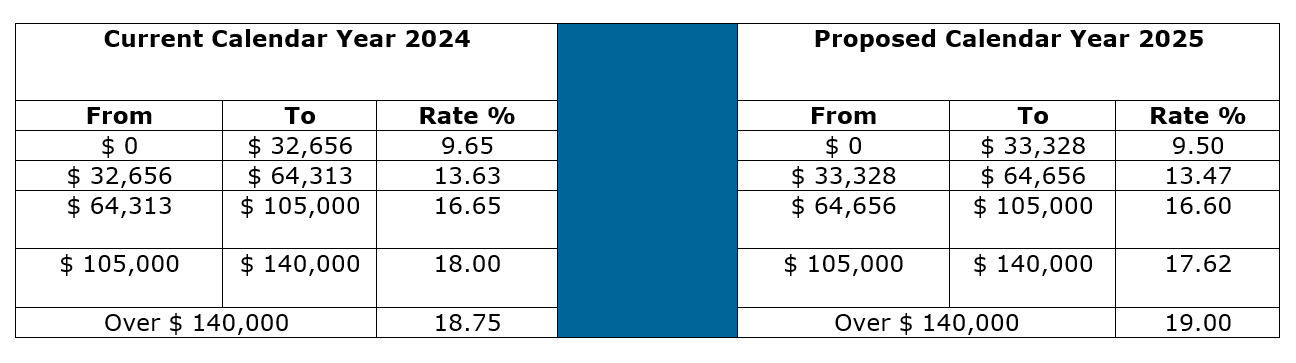
In January 2026, all five tax brackets will be increased by 1.8% and the basic personal amount to $15,000, accelerating tax changes a full year earlier than originally planned.
New tax measures proposed in the 2024 budget (February 29, 2024):
Income Tax Brackets and Rates
-
PEI Children's Benefit
The budget introduces a new monthly income-based PEI Children's Benefit starting in January 2025. The budget notes that a family with two children with a net household income of up to $45,000 will receive $720 per year under the new benefit. Families with incomes between $45,000 and $80,000 will receive a prorated benefit. The PEI Children's Benefit will be administered through the CRA and will be reviewed annually.
Nova Scotia
New tax measures proposed in the 2025 budget (February 18, 2025):
The supplements to the basic personal, spousal, eligible dependant and age amounts are eliminated, and the amounts are increased so that the previous supplement is now included in the amounts. 2025 basic personal amount (BPA) increased to $11,744. Spouse/eligible dependant amounts increased to $11,744. Age amount increased to $5,734 but still reduced at the rate of $0.15 per $1 over the income threshold. As provided in 2024 budget, tax brackets are indexed starting January 1st, 2025. Effective April 1st, 2025, the HST rate will be reduced by one per cent to 14 per cent.
New Brunswick
New tax measures proposed in the 2025 budget (March 18, 2025):
N/C
New tax measures proposed in the 2024 budget (March 19, 2024):
-
Low-Income Seniors' Benefit
Permanent increase to the base amount of the Low-Income Seniors' Benefit to $600 from $400, with the $600 benefit for 2024 indexed to the consumer price index annually starting in 2025. Applications for the 2024 benefit will be available on April 1st, 2024.
Quebec
New tax measures proposed in the 2025 budget (March 25, 2025):
-
Enhancing the Family Allowance for bereaved parents
The refundable tax credit granting an allowance to families (hereinafter referred to as the "RTCAF") provides financial assistance to families with children under the age of 18 to help them meet the needs of these children.
This tax credit consists of the Family Allowance, the Supplement for Handicapped Children (SHC), the Supplement for Handicapped Children Requiring Exceptional Care (SHCREC) and the Supplement for the Purchase of School Supplies.
The Family Allowance, which has a universal base, is determined notably on the basis of family income, so that additional assistance is granted to low- and middle-income families. The three supplements are granted to eligible families regardless of family income.
Retraite Québec is responsible for administering and paying the RTCAF and makes the payments on a quarterly basis, with the exception of the component relating to the Supplement for the Purchase of School Supplies, which is paid in a single, separate instalment.
Death of a child
In the event of the death of a minor child in Québec, the Directeur de l'état civil informs Retraite Québec, so that the parents of an eligible dependent child for the application of the RTCAF do not have to take any steps with the organization. However, when the death of an eligible dependent child occurs outside Québec, Retraite Québec must be notified by the parents.
Extension of payments for 12 months
To ensure a fairer and more uniform treatment of RTCAF payments to grieving parents, the tax legislation will be amended to provide that Family Allowance payments, as well as SHC or SHCREC payments, where applicable, will be extended for 12 months from the month following the month that includes the day of an eligible dependent child's death.
Clarification
For greater clarity, the extension of payments, where applicable, will only apply to children for whom Family Allowance payments were already being made at the time of the child's death.
In addition, no amount will be granted for any month subsequent to that in which the child would have reached the age of majority, but for the child's death.
In the event that the death of a minor child gives entitlement to other government death benefits in respect of that child, there will be no reduction in the amounts provided for in this announcement.
-
Change to the deduction in respect of the cooperative investment plan
The objective of the deduction in respect of the second cooperative investment plan (hereinafter referred to as the "CIP deduction") is to encourage the capitalization of certain cooperatives by granting members and workers who acquire qualifying securities a deduction in calculating their taxable income.
Since the CIP deduction is rarely used and that other measures are available to support cooperatives, the tax legislation will be amended so that, for the purposes of the CIP deduction, the adjusted cost of a qualifying security for an individual will be the cost of that security, determined without taking into account borrowing costs and other costs related to the acquisition, instead of 125% of such cost.
This change will apply in respect of a qualifying security acquired after March 25, 2025. For greater clarity, the rules relating to the 30% limit on total income applicable to the CIP deduction remain unchanged.
-
Abolishing the foreign expert tax holiday
The foreign expert tax holiday was implemented as part of the March 9, 1999, budget speech. Its objective is to facilitate the recruitment of individuals specialized in the valorization of the results of scientific research and experimental development (SR&ED) projects by businesses carrying on such activities in Québec. The government's review of tax expenditures has revealed that the foreign expert tax holiday entailed a significant administrative burden and failed to achieve its objectives effectively. This measure will therefore be abolished as of March 26, 2025.
Consequently, the Minister of Economy, Innovation and Energy will not accept any new application for the issuance of an expert qualification certificate in respect of a new eligible activity period as of March 26, 2025. For greater clarity, this abolition will not impact the eligibility of individuals for whom an expert qualification certificate is held by the eligible employer in respect of an eligible activity period or for whom an application for the issuance of an expert qualification certificate has been filed by the eligible employer to the Minister of Economy, Innovation and Energy on or before March 25, 2025, in respect of such a period. These individuals will be able to benefit from the foreign expert tax holiday under the current rules.
-
Abolishing the tax holiday for foreign specialists assigned to operations of an international financial centre
The tax holiday for foreign specialists assigned to operations of an international financial centre (hereinafter referred to as the "tax holiday for foreign specialists of an IFC") was implemented as part of the April 23, 1985 budget speech. Its objective is to facilitate the recruitment of foreign specialists in the field of international financial transactions or in a field relating to the activities provided for in one or more eligible contracts by an international financial centre. The government's review of tax expenditures has revealed that the tax holiday for foreign specialists of an IFC was underutilized and failed to achieve its objectives effectively. This measure will therefore be abolished as of March 26, 2025.
Consequently, the Minister of Finance will not accept any new application for the issuance of a specialist qualification certificate as of March 26, 2025. For greater clarity, this abolition will not impact the eligibility of individuals for whom a specialist qualification certificate is already held by the eligible employer or for whom an application for the issuance of a specialist qualification certificate has been filed by the eligible employer to the Minister of Finance on or before March 25, 2025. These individuals will be able to benefit from the tax holiday for foreign specialists of an IFC under the current rules.
-
Abolishing the tax holiday for foreign specialists working in the financial services sector
The tax holiday for foreign specialists working in the financial services sector (hereinafter referred to as the "foreign specialist tax holiday") was implemented as part of the March 20, 2012 budget speech. Its objective is to facilitate the recruitment of foreign specialists with a high level of expertise in the field of finance by new financial services corporations. The government's review of tax expenditures has revealed that the foreign specialist tax holiday was underutilized and failed to achieve its objectives effectively. This measure will therefore be abolished as of March 26, 2025.
Consequently, the Minister of Finance will not accept any new application for the issuance of a specialist qualification certificate as of March 26, 2025. For greater clarity, this abolition will not impact the eligibility of individuals for whom a specialist qualification certificate is already held by the eligible employer or for whom an application for the issuance of a specialist qualification certificate has been filed by the eligible employer to the Minister of Finance on or before March 25, 2025. These individuals will be able to benefit from the foreign specialist tax holiday under the current rules.
-
Abolishing the tax holiday for seamen engaged in international transportation of freight
The tax holiday for seamen engaged in international transportation of freight (hereinafter referred to as the "tax holiday for seamen") was implemented as part of the May 9, 1996 budget speech. Its objective is to improve the competitiveness of eligible shipowners and encourage them to hire more Québec seamen. The government's review of tax expenditures has revealed that the tax holiday for seamen has failed to achieve its objectives effectively. This measure will therefore be abolished as of March 26, 2025.
Consequently, the Minister of Transport will not accept any new application for the issuance of a seaman certificate or a vessel certificate as of March 26, 2025. For greater clarity, this abolition will not impact the eligibility of individuals for whom a certificate has already been issued or who have already applied to the Minister of Transport for the issuance of a certificate on or before March 25, 2025. These individuals will be able to benefit from the tax holiday for seamen under the current rules.
-
Abolishing the tax credit for patronage gift
The tax credit for patronage gift (hereinafter referred to as the "cultural patronage tax credit") was introduced on July 3, 2013. Its objective is to recognize the importance of the patronage role of certain individuals in funding cultural organizations. The government's review of tax expenditures has revealed that the cultural patronage tax credit remains underutilized, and that the Mécénat Placements Culture program, the funding for which is enhanced in this budget, provides better support for organizations working in the field of culture and communications. In this context, this tax credit will be abolished as of March 26, 2025.
For greater clarity, an individual, or the individual's succession, who will have registered a pledge with the Minister of Culture and Communications on or before March 25, 2025, will continue to benefit from the cultural patronage tax credit in respect of such donation, under the current terms and conditions. Furthermore, registered pledges will continue to be subject to the provisions governing failure to honour a pledge. Similarly, the abolition of the cultural patronage tax credit will not affect the carry-forward and carry-back periods of the individual or the individual's succession, as the case may be, in respect of a patronage gift made on or before March 25, 2025.
-
Strengthening tax compliance with respect to foreign property held by Quebecers
The Canada Revenue Agency (CRA) has been requiring, for several years now, that Canadian taxpayers report annually any foreign property with a total cost exceeding $100 000 at any time during the year. Until now, Revenu Québec used the usual information exchange mechanism with the CRA to obtain relevant information.
Introducing a new reporting requirement for foreign property held outside Canada
Changes will be made to the Québec tax system to introduce a new reporting requirement for Québec taxpayers in respect of foreign property held outside Canada.
This requirement will be satisfied by a new prescribed form, similar to federal Form T1135.
Definition of "designated foreign property"
For the purposes of the Québec tax system, designated foreign property that will be subject to the new reporting requirement will be essentially the same as foreign property subject to the federal tax legislation, with the necessary adaptations. More specifically, designated foreign property will mean:
funds or incorporeal property situated, deposited or held outside Canada; corporeal property situated outside Canada; share of the capital stock of a corporation not resident in Canada; an interest in a trust not resident in Canada; an interest in a partnership that owns or holds designated foreign property; an interest in, or rights with respect to, an entity not resident in Canada; indebtedness owed by a person not resident in Canada; a right to any property (other than any property owned by a corporation or trust that is not the person) that is designated foreign property or rights with respect to such property, either immediately or in the future and either absolutely or contingently and under a contract; property that is convertible into, is exchangeable for or confers a right to acquire, property that is designated foreign property.
Property that is not "designated foreign property"
The following property will not constitute designated foreign property:
property that is used or held exclusively in the course of carrying on an active business of the person or partnership (determined as if the person or partnership were a corporation resident in Canada); a share of the capital stock or indebtedness of a corporation not resident in Canada that is a foreign affiliate corporation or a foreign affiliate of the person or partnership; an interest in, or indebtedness of, a trust not resident in Canada that is a foreign affiliate corporation or a foreign affiliate of the person or partnership; an interest in a trust not resident in Canada that was not acquired for consideration by either the person or partnership or by a person related to the person or partnership; an interest in a trust that is described in paragraph (a) or (b) of the definition "exempt trust"; an interest in a partnership that is a specified Canadian entity or a designated Québec entity; a right with respect to, or indebtedness of, an authorized foreign bank that is issued by, and payable or otherwise enforceable at, a branch in Canada of the bank; personal-use property of the person or partnership; a right in, or a right to acquire, a property that is any excluded property aforementioned.
Definition of "reporting entity"
Any "designated Quebec entity" holding foreign property will have to declare it when its value exceeds $100 000, at any time in the taxation year or fiscal period, other than a time when the person or entity is not resident in Canada.
Definition of "designated Quebec entity"
Subject to certain exceptions, a "designated Québec entity" will mean:
an individual resident in Québec; a corporation that simultaneously resides in Canada and has an establishment in Québec; a trust that is a resident in Québec; a partnership where the partner's share of the income or loss is less than 90% of the partnership's income or loss for the fiscal period.
Filing-due date of the new Québec prescribed form
The new form will need to be filed with Revenu Québec on the same date as the income tax return, except for partnerships, in which case the filing-due date will be the same as that of their information return.
Introducing new penalties
Designated Quebec entities that fail to comply with the reporting requirement will be subject to penalties corresponding to those under the federal tax system, in particular:
a penalty for failing to file the new Québec form of $500 per month or part of a month for a maximum of 24 months, that is, a maximum of $12 000, and, where the entity has been given formal notice to file the new return and has failed to meet the deadline, the double of that amount; an additional penalty for failing to file the report for more than 24 months set at 5% of the total cost of the designated foreign property; a penalty in case of false statement or omission equal to or higher than $24 000 or 5% of the total cost of designated foreign property.
Extending the assessment period
In order to enable Revenu Québec to effectively administer this new reporting requirement for designated foreign property, a longer period for assessment or reassessment will be introduced into the Québec tax legislation.
As in the federal tax legislation, an extension of three years after the end of the normal reassessment period for the taxpayer in respect of the year will apply if:
the taxpayer, or a partnership of which the taxpayer is a member, has failed to file the prescribed form as and when required or to report on the prescribed form the information required in respect of a designated foreign property held by the taxpayer; and the taxpayer has failed to report, in the return of income an amount in respect of a designated foreign property that is required to be included in computing the taxpayer's income for the year.
Application date
These measures will apply as of a date to be determined by the government after the assent of the bill giving effect to them.
-
Income tax measures
Québec tax legislation and regulations will be amended to incorporate some of the income tax measures proposed in the 2024 Fall Economic Statement. However, the amendments to the Québec tax system will be adopted only after the assent of any federal legislation or the adoption of any federal regulation giving effect to the retained measures. These amendments will be applicable on the same dates as the federal measures with which they are harmonized.
Measures retained
Québec tax legislation and regulations will be amended to incorporate the measures relating to:
- the exemption of the Canada Disability Benefit from tax;
- capital gains rollover on investments;
- reporting by non-profit organizations;
- the scientific research and experimental development tax incentive program (SR&ED), with respect to the eligibility of capital expenditures for the deduction relating to SR&ED expenditures;
- the extension of the Accelerated Investment Incentive and immediate expensing measures, subject to the rules set out below.
Rules relating to the extension of the Accelerated Investment Incentive and immediate expensing measures
The Department of Finance Canada proposes changes with respect to the capital cost allowance so as to fully reinstate the Accelerated Investment Incentive and immediate expensing measures for qualifying property acquired on or after January 1, 2025, and that becomes available for use before 2030.
Qualifying intellectual property included in Class 14.1
The Québec tax system is generally harmonized with the federal tax system with respect to the Accelerated Investment Incentive. However, property that is a qualifying intellectual property included in Class 14.1 and which becomes available for use before 2026 benefits from a temporary accelerated capital cost allowance under the Québec tax system. Consequently, such a property will continue to benefit from the tax treatment granted under the Québec tax system.
Deduction for Canadian development expenses
The extension of the Accelerated Investment Incentive will not apply to the deduction for cumulative Canadian development expenses claimed by a development corporation carrying on a mining business, neither will it apply to the deduction for cumulative Canadian development expenses incurred in Québec claimed by a development corporation carrying on an oil business.
-
Adjusting the flow-through share regime
To simplify the flow-through share regime and thereby harmonize it with the federal system, in Budget 2025-2026, the government is announcing the abolition of two additional deductions, namely:
the deduction for mining exploration expenses incurred in Québec by a corporation that does not mine a mineral resource (10%); the deduction for surface mining exploration expenses incurred in Québec by a corporation that does not mine a mineral resource (10%)
Budget 2025-2026 provides for the abolition of these additional deductions for flow-through shares issued after the day of the budget speech.
Under the federal and Québec tax systems, the price paid to acquire flow-through shares is deemed to be nil, since such property generally qualifies for significant tax deductions.
However, when flow-through shares are disposed of, the Québec regime is more generous, providing an additional capital gains exemption in respect of certain resource properties, which generally allows the capital gain generated by the disposal to be fully offset.
In order to harmonize the treatment of the acquisition and disposal of flow-through shares with federal legislation, Budget 2025-2026 will abolish the additional capital gains exemption in respect of certain resource properties for the disposal of flow-through shares after the day of the budget speech.
Budget 2025-2026 - Budget Plan
-
Tax credit for career extension
The age of eligibility for the tax credit has been 60 years since 2019 and will be raised to 65 years starting in 2025.
Ontario
New tax measures proposed in the 2025 budget (15 May 2025):
-
Fertility treatment tax credit
Announced last year, the Ontario Fertility Treatment Tax Credit will cover 25 per cent of eligible fertility treatment plans up to $20,000 for a maximum credit of $5,000.
Eligible fertility-related expenses would generally be the same as those claimed for the Ontario medical expense tax credit – provided they are in respect of goods or services provided entirely in Canada. This new refundable tax credit could be claimed in addition to the non-refundable federal and Ontario medical expense tax credits already available for the same eligible expenses.
New tax measures proposed in the 2024 budget (March 26, 2024):
-
Ontario Taxpayer Rebate
Providing a $200 taxpayer rebate early next year, which would give immediate relief for Ontario families in the face of high interest rates and the federal carbon tax. This proposed $200 taxpayer rebate would be sent to all eligible adults in Ontario who have filed their 2023 Income Tax and Benefit Return by December 31, 2024. Eligible families would receive an additional $200 for each child under 18.
Manitoba
New tax measures proposed in the 2025 budget (March 20, 2025):
-
Freezing indexation of the Basic Personal Amount (BPA) and tax thresholds
The 2025 BPA and thresholds will be unchanged from 2024. The phase-out of the BPA over a net income range of $200,000 to $400,000 for 2025, as was planned in the 2024 Budget, is still in effect.
-
Doubling the Volunteer Firefighter and Search and Rescue Amount
Volunteer Firefighter and Search and Rescue Amount is doubled from $3,000 to $6,000 for the 2025 tax year.
New tax measures proposed in the 2024 budget (April 2, 2024):
-
New 1,500 $ Homeowners Affordability Tax Credit
Budget 2024 has additional measures to lower costs for families. Beginning in 2025, the new $1,500 Homeowners Affordability Tax Credit will make it easier to own a home. And families who need the most help making mortgage payments will have their education property taxes eliminated entirely. Renters and seniors will see additional savings with increased tax credits.
-
Restoring the Renters Tax Credit
Starting in tax year 2025, the maximum annual Renters Tax Credit will be increased to $575, and the maximum seniors' top-up will increase from $300, to $328.57.
Saskatchewan
New tax measures proposed in the 2025 budget (March 19, 2025):
-
Fertility Treatment Tax Credit
The budget introduces a Fertility Treatment Tax Credit effective January 1, 2025. Generally, this 50% refundable tax credit is available for one lifetime fertility treatment expense claim per tax filer, including related prescription drug costs, for eligible treatments and costs incurred in Saskatchewan. Individuals can claim a maximum of $20,000 in eligible expenses.
-
Small and Medium Enterprise Investment Tax Credit
The budget introduces a new Small and Medium Enterprise Investment Tax Credit, effective July 1, 2025. Note that both qualified individuals and corporations are able to claim this non-refundable tax credit on 45% of equity investment in an eligible small and medium-sized enterprise. An eligible business is one that employs between five to 49 employees, of whom at least 50% reside in Saskatchewan. The eligible business must also be in the food and beverage manufacturing sector or the machinery and transportation equipment manufacturing sector.
-
Saskatchewan December 2024 Affordability Measures
Bill 30, Saskatchewan Affordability Act - December 2, 2024.
This Act received Royal Assent on December 10, 2024, and contained the following provisions:
- Increased the 2025 basic personal amounts (BPA) and spousal amounts by $500 to $19,491. These amounts will be indexed in subsequent years, and for tax years 2026 to 2028 $500 will be added to the indexed amounts, with regular indexing resumed in 2029.
- The dependent child 2025 tax credit is also increased by $500 for 2025, to $7,704, with increases in the same manner as the BPA for 2026 to 2028.
- Senior supplementary amount is increased by $500 to $2,028, with increases in the same manner as the BPA for 2026 to 2028.
- Disability amount, and the additional amount for individuals under 18, have increased by 25%, in addition to inflation, to $13,986, with increases in the same manner as the BPA for 2026 to 2028.
- In-home care of relative amount increased by 25% to $13,986 for 2025, to be indexed as usual in subsequent years.
- Infirm dependant amount increased by 25% to $13,986 for 2025, to be indexed as usual in subsequent years.
- Home renovation tax credit is reintroduced for 2025 and 2026.
- First-time homebuyers' credit is increased to $15,000 for 2025 and subsequent tax years.
- The active families benefit and the income threshold to qualify for it, are doubled.
- The Graduate Retention Program's tax credit benefits will increase by 20%, from $20,000 to $24,000, for those who graduate on or after October 1, 2024.
- Non-eligible dividend tax credit changes for 2025 and 2026 cancelled. This results in a change to the marginal tax rates for these dividends.
- Beginning July 1, 2025, the Low-Income Tax Credit will increase by 5% annually for the next 4 years, in addition to indexation.
Alberta
New tax measures proposed in the 2025 budget (February 27, 2025):
-
New 8% personal income tax bracket
The Alberta government is keeping its promise to lower income taxes for Albertans by introducing a new personal income tax bracket of 8% on the first $60,000 of income, effective January 1, 2025.
-
New supplemental non-refundable tax credit
A new supplemental non-refundable tax credit was introduced, which is equal to 2% of the total amount of certain non-refundable tax credits claimed by an individual that exceeds $60,000. This credit will be indexed starting in 2026.
British Columbia
New tax measures proposed in the 2025 budget (March 4, 2025):
-
Extending the Clean Buildings Tax Credit's deadline for qualifying expenditures
The deadline for qualifying expenditures for the clean buildings tax credit is extended by one year to March 31, 2026. The temporary credit supports the government's CleanBC plan by incentivizing energy efficiency upgrades that go above and beyond minimum requirements for existing buildings. Reducing a building's energy use can reduce its environmental impact. Improved energy efficiency can provide additional benefits such as increased affordability through reduced heating and cooling costs and improved health and comfort.
-
BC Family Benefit Amended for Grieving Families
Effective January 1, 2025, the BC Family Benefit is amended to continue payments for six months following a child's death. This amendment harmonizes with the federal amendment to the Canada Child Benefit.
-
Increasing the limit for the Small Business Venture Capital Tax Credit
The annual credit limit that an individual can claim for investments made on or after March 4, 2025, is increased from $120,000 to $300,000, effective for 2025 and subsequent taxation years.
-
Training Tax Credit for Apprentices Extended and Amended
The training tax credit for individuals will be extended for three years, to the end of 2028. The program is also amended effective April 1, 2025, so that those who are eligible for the enhanced credit for First Nations individuals or persons with a disability continue to receive the enhanced credit after the federal Apprenticeship Incentive Grant expires on March 31, 2025. Currently, the amount of the enhanced training tax credit is tied to the amount received under the federal grant. First Nations individuals and persons with a disability are under-represented in the trades and face challenges completing their training. The training tax credit for individuals supports a diverse workforce by providing an enhanced credit for First Nations apprentices and apprentices with disabilities.
Yukon
New tax measures proposed in the 2025 budget (March 6, 2025):
-
New tax credit for fertility treatments and surrogacy services
A new refundable tax credit was introduced, allowing taxpayers to claim 40% of costs incurred for fertility treatments and surrogacy services, up to a maximum of $10,000, starting with the 2025 taxation year.
-
Amendments to align with the federal changes to alternative minimum tax
- The 2025 Yukon percentage for the calculation of minimum tax will be 43.90%, where it previously was 42.67%, multiplied by the additional federal tax.
- The previous rate of 42.67 was based on the lowest personal Yukon and Federal tax rates, or 6.4%/15%.
- The 2025 rate of 43.90% is based on the Yukon and Federal tax rates for the 2nd tax bracket, or 9%/20.5%.
- The rate of 42.67% will still be used for minimum tax carryover amounts that originate in a tax year prior to 2025.
Northwest Territories
New tax measures proposed in the 2025 budget (February 6, 2025):
N/C
Nunavut
New tax measures proposed in the 2025 budget (February 24, 2025):
-
Extending eligibility for the volunteer firefighter tax credit to search and rescue volunteers
On October 25, 2024, the Nunavut government tabled Bill 65, An Act to Amend the Income Tax Act to extend eligibility for the volunteer firefighter tax credit to search and rescue volunteers.
June 16, 2025
|